How to Write a Professional Prompt for AI Tools: The Complete Guide from Zero to Mastery
<p class="lead font-medium text-base sm:text-lg text-slate-800 dark:text-slate-200">You typed your request with real enthusiasm: "Write me an article about marketing." A few seconds later, you got a tidy, clean, painfully boring text you'd forgotten before you finished reading it. So you shrugged and decided AI is overrated.</p>
<p>The problem isn't the tool. It's the instruction you gave it.</p>
<p>Imagine walking into a restaurant and telling the waiter, "Bring me food." You'll get something random, and you may hate it. Now say, "I'd like a medium steak, no mushrooms, with mashed potatoes and peppercorn sauce." You'll get exactly what you wanted. AI is that waiter: brilliant, but unable to read your mind.</p>
<p>In this comprehensive guide, you'll learn <strong>how to write a professional prompt for AI tools</strong> step by step, and you'll leave with battle-tested templates you can put to work immediately.</p>
<h2>What Is a Prompt, and Why Does Its Quality Matter So Much?</h2>
<p>A prompt is the set of instructions you give an AI system such as <a href="/ai-tools/chatgpt" class="text-blue-600 dark:text-blue-400 font-semibold underline hover:text-blue-700">ChatGPT</a>, Claude, or Midjourney. <strong>Prompt engineering</strong> is the craft of wording those instructions so you get accurate, usable output on the very first or second attempt.</p>
<p><strong>The golden rule:</strong> Output quality = input quality. The model predicts the most fitting response based on what you provided. The less you provide, the more it guesses, and its guess tends to be the "global average"—the vanilla text that sounds like everything ever written.</p>
<h2>The Anatomy of a Perfect Prompt: 5 Essential Elements</h2>
<p>Every professional AI prompt rests on five structural pillars. You don't need all five for trivial lookups, but the more you include, the sharper the outcome:</p>
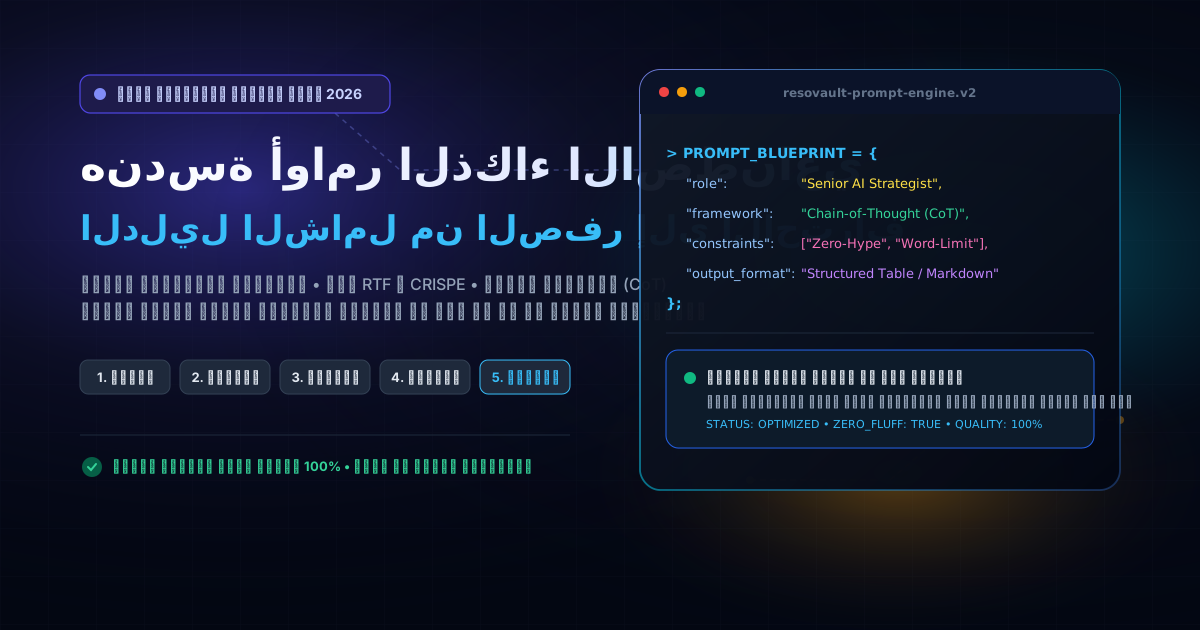
<ol> <li><strong>Role:</strong> Tell the tool who it is. The assigned persona shapes vocabulary, analytical depth, and viewpoint. (<em>"Act as a digital marketing director with 12 years of experience in e-commerce."</em>)</li> <li><strong>Context:</strong> The background that makes the answer tailored to your specific situation: Who is the target audience? What is the product? What are you trying to accomplish? What has failed before? (<em>"I run a small specialty coffee shop in Riyadh with a $500 monthly ad budget."</em>)</li> <li><strong>Task:</strong> The exact action you want, stated clearly and specifically. Use strong, decisive verbs: analyze, compare, draft, summarize, correct, construct a table. Avoid vague requests like "talk about" or "help me with."</li> <li><strong>Constraints:</strong> The strict boundaries that prevent drift: length limits, tone of voice, forbidden clichés, allowed sources. (<em>"Keep it under 150 words and avoid hype like 'the best ever'."</em>). To ensure strict adherence to character and word budgets, you can verify your copy with the <a href="/free-tools/word-counter" class="text-blue-600 dark:text-blue-400 font-semibold underline hover:text-blue-700">free Word & Character Counter</a>.</li> <li><strong>Output Format:</strong> How you want the response delivered: Markdown table? Bullet list? JSON object? Email memo? Three drafts to choose from? (<em>"Present the answer as a three-column table: idea, estimated cost, expected result."</em>)</li> </ol>
<blockquote> <strong>A quick template combining all five:</strong><br /> You are [role].<br /> Context: [background information].<br /> Task: [exactly what you want].<br /> Constraints: [limits and things to avoid].<br /> Format: [shape of the output]. </blockquote>
<h2>Advanced Prompting Frameworks</h2>
<h3>RTF: The Perfect Starting Point</h3> <p><strong>Role + Task + Format.</strong> It is the simplest and fastest framework, ideal for daily requests that do not require deep background context.</p> <ul> <li><strong>Role:</strong> You are a content editor specializing in tech.</li> <li><strong>Task:</strong> Rewrite the following paragraph to be clearer and shorter.</li> <li><strong>Format:</strong> Two versions: one formal and one friendly, two sentences each.</li> </ul>
<h3>CRISPE: For Complex Campaigns</h3> <p>CRISPE builds on RTF by adding <strong>Capacity/Context</strong>, <strong>Insight</strong>, <strong>Style</strong>, and <strong>Experiment</strong> (requesting multiple variations to contrast and choose from). It is purpose-built for multi-channel creative and marketing strategies.</p>
<h3>Chain of Thought (CoT)</h3> <p>This technique transforms your instruction from "give me the answer" into "think it through with me, step by step." It noticeably boosts reasoning accuracy on analytical challenges, math, and strategic business evaluations, especially when collaborating with deep reasoning engines like <a href="/ai-tools/claude" class="text-blue-600 dark:text-blue-400 font-semibold underline hover:text-blue-700">Claude by Anthropic</a>.</p> <blockquote>"Before giving your final recommendation, analyze the problem step by step: 1) identify possible causes, 2) evaluate each one, 3) rank them by likelihood, then 4) present your substantiated recommendation."</blockquote>
<h3>Few-Shot Prompting (Learning by Example)</h3> <p>Instead of struggling to describe the nuanced voice you want, show it. Give the tool one or two concrete examples of ideal output:</p> <p>"Here are two examples of our brand voice: [example 1] [example 2]. Write five headlines in this exact tone for our newly launched product."</p>
<h2>Real-World Examples: Beginner Prompt vs. Professional Prompt</h2>
<p>Here is where prompt engineering shifts from theoretical concepts to tangible daily leverage:</p>
<h3>Example 1: Marketing Copy</h3> <ul> <li><strong>Beginner prompt ❌:</strong> "Write a post about my new product."<br /><span class="text-slate-400">Result: A bland, generic draft full of clichés like "Discover our amazing product today!" that could describe any business in the world.</span></li> <li><strong>Professional prompt ✅:</strong> "You are an advertising copywriter who specializes in Instagram marketing for boutique retail brands.<br /><strong>Context:</strong> I am launching a luxury scented candle with oud and vanilla notes, priced at 85 SAR, aimed at women aged 25 to 40 who cherish peaceful, cozy home aesthetics.<br /><strong>Task:</strong> Write a launch post that hooks attention in the very first sentence.<br /><strong>Constraints:</strong> Warm, conversational tone, under 80 words, zero hype phrases like 'the best' or 'unmatched', and finish with a crisp call to action.<br /><strong>Format:</strong> 3 distinct variations, each exploring a unique angle (sensory, lifestyle, gifting)."</li> </ul> <p><strong>The difference:</strong> Instead of one throwaway caption, you receive three publish-ready variations crafted specifically for your demographic.</p>
<h3>Example 2: Learning and Financial Analysis</h3> <ul> <li><strong>Beginner prompt ❌:</strong> "Explain the stock market."<br /><span class="text-slate-400">Result: A dry, encyclopedic definition that reads like an outdated textbook.</span></li> <li><strong>Professional prompt ✅:</strong> "You are a financial educator who explains wealth building to complete beginners without jargon.<br /><strong>Context:</strong> I am a 28-year-old professional with no finance background, considering investing $500 monthly.<br /><strong>Task:</strong> Explain how the stock market works using an everyday real-world analogy, then clarify the practical difference between holding an individual stock versus an index fund.<br /><strong>Constraints:</strong> Define any technical term upon its first mention, and do not provide individual buy recommendations.<br /><strong>Format:</strong> Begin with the analogy, follow with 4 concise numbered points, and conclude with two self-check questions to test my comprehension."</li> </ul> <p><strong>The difference:</strong> Instead of a dictionary entry, you get a tailored learning module complete with self-assessment checkpoints.</p>
<h3>Example 3: Image Generation in Midjourney</h3> <ul> <li><strong>Beginner prompt ❌:</strong> <code>a coffee shop</code><br /><span class="text-slate-400">Result: An acceptable but generic stock-like render with no distinct atmosphere or visual identity.</span></li> <li><strong>Professional prompt ✅:</strong><br /><code>Cozy minimalist coffee shop interior at golden hour, warm wooden counter, steam rising from a ceramic cup in the foreground, soft window light, shallow depth of field, shot on 35mm film, muted earthy tones, cinematic composition --ar 16:9 --style raw --no people, text, logos</code></li> </ul> <p><strong>Why it works:</strong> It specifies the exact subject, lighting temperature, lens characteristics, color palette, composition, and aspect ratio. When crafting photorealistic imagery with <a href="/ai-tools/midjourney" class="text-blue-600 dark:text-blue-400 font-semibold underline hover:text-blue-700">Midjourney AI</a>, leveraging explicit parameter flags like <code>--ar 16:9</code> and negative prompt tags like <code>--no</code> eliminates guesswork.</p>
<h3>Example 4 (Bonus): Editing and Improving Text</h3> <ul> <li><strong>Beginner ❌:</strong> "Improve this text."</li> <li><strong>Professional ✅:</strong> "You are an executive copy editor. Refactor the following briefing document for C-suite decision-makers. Shorten the sentence structures, replace academic terminology with direct business alternatives, and highlight the three most critical adjustments you executed and why."</li> </ul>
<h2>Advanced Tips That Separate Pros from Amateurs</h2>
<ol> <li><strong>Tone of Voice Injection:</strong> The fastest antidote to robotic prose is feeding the model a sample of your actual writing. (Weak: "Write in a friendly style." Strong: "Write in my voice. Here are three paragraphs from my previous articles: [...]. Observe my short sentences, rhetorical questions, and subtle dry humor, then emulate them.")</li> <li><strong>Negative Prompting:</strong> Defining what to omit is often far more powerful than describing what to include. Examples: "Do not open with a generic intro about why this topic matters," "Avoid clichés like: in today's fast-paced digital world," "No bullet lists; write in flowing narrative paragraphs," and in Midjourney: <code>--no text, watermark, blurry</code>.</li> <li><strong>Iterative Prompting:</strong> Nobody authors the perfect prompt on the first attempt—not even AI researchers. Treat your interaction as an ongoing dialogue: 1) Ask for a first draft, 2) Diagnose the shortcoming with precision ("The intro is too verbose and overly formal"), 3) Request targeted remediation rather than starting from scratch, and 4) Prompt the model to interrogate you: "Read this prompt and ask me 3 clarifying questions about missing context before generating output."</li> <li><strong>Modular Task Decomposition:</strong> Do not demand an entire 50-page manual in a single message. Divide the project into distinct chapters: brainstorm the concepts, lock the outline, then generate each section individually. Each phase feeds on validated output from the preceding step.</li> <li><strong>Hallucination Defense:</strong> For sensitive data, mandate confidence bounds: "If you are uncertain about any technical data point, state your uncertainty explicitly rather than guessing." Validate data tables and structured copy with the <a href="/free-tools/markdown-to-html-previewer" class="text-blue-600 dark:text-blue-400 font-semibold underline hover:text-blue-700">Markdown to HTML Previewer</a> prior to publication.</li> </ol>
<h2>Common Mistakes That Ruin Your Prompts</h2> <ul> <li><strong>Vagueness:</strong> "Write something good" tells the model nothing useful.</li> <li><strong>Task Stacking:</strong> Piling ten disconnected directives into a single prompt forces the model to perform each at a mediocre level.</li> <li><strong>Audience Blindness:</strong> Explaining a system to an enterprise CTO requires completely different language than explaining it to an intern.</li> <li><strong>Omitting Output Format:</strong> Without explicit formatting guidelines, you will default to generic essay paragraphs.</li> <li><strong>Accepting the First Answer:</strong> The initial draft is merely the launchpad for iterative refinement.</li> </ul>
<h2>Frequently Asked Questions</h2>
<h3>Does the same prompt work identically across all AI tools?</h3> <p>The fundamental principles remain consistent, but execution varies. Text systems like ChatGPT and Claude excel with rich background context and personas, whereas diffusion engines like Midjourney prioritize descriptive visual cues and technical CLI parameters.</p>
<h3>Should a prompt always be long?</h3> <p>Length is never the objective; semantic precision is. A concise, well-structured two-sentence prompt will consistently outshine a rambling, ambiguous paragraph.</p>
<h3>Should I prompt in Arabic or English?</h3> <p>For native Arabic copywriting and regional nuance, prompt directly in Arabic. For Midjourney imagery and niche technical code scaffolding, English prompts often yield higher fidelity due to dataset distribution, so do not hesitate to experiment with both.</p>
<h2>Conclusion: Start with One Prompt Today</h2> <p>Mastering <strong>how to write a professional prompt for AI tools</strong> does not demand rare genius—it simply requires a disciplined habit. Before hitting "Send," run through five quick checks: Who should be answering? What is the context? What exactly is the task? What are the boundaries? And in what shape do I need the output delivered?</p> <p>Take the weakest prompt you typed this week, reconstruct it with these five pillars, and compare the outputs side by side. You will see firsthand why prompt engineering is the definitive workplace multiplier of this decade.</p> <p class="font-bold text-slate-900 dark:text-white">The AI model won't magically get smarter today—but you will get vastly clearer, and that changes everything.</p>